Bevel Review (2026): Is the Priciest Health App Worth It?
How do we vet apps & products? Learn more.
Most health apps pick a lane: sleep, strain, nutrition, cycle tracking. Bevel doesn't. It tries to be the one app that replaces four or five of them, pulling in Apple Watch, Oura, Garmin, and Fitbit data and turning it into daily Recovery, Sleep, Strain, and Stress scores, plus AI-driven food logging and a strength-training plan. It's ambitious, it's rated 4.8 stars from over 13,000 App Store reviews, and — as of mid-2026 — it's also the most expensive subscription in its category. We spent time with the free tier and Bevel Pro to see whether the breadth justifies the price.
| Our Rating | 4.0 / 5 |
| Price | Free + Pro $14.99/mo or $99.99/yr |
| Type | All-in-one health & recovery app |
| Platform | iPhone (iOS 18+); reads Apple Watch, Oura, Garmin, Fitbit |
| Where to get it | App Store |
What Bevel Actually Is
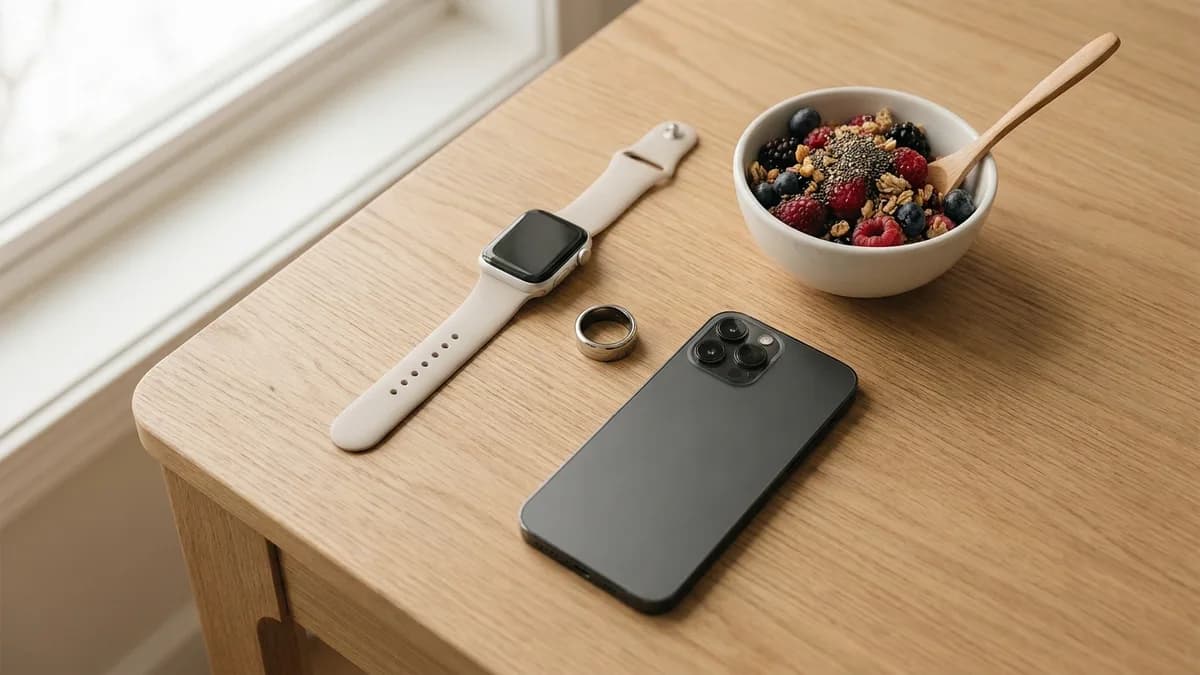
Bevel bills itself as an "AI health coach," but underneath the branding it's closer to a data consolidator with a coaching layer bolted on top. It reads whatever wearable data your iPhone already has access to — Apple Watch through HealthKit, Oura Ring and Garmin through direct integrations that bypass Apple Health for faster syncing, and Fitbit via Google Health — and boils it down into four daily numbers: Recovery, Sleep, Strain, and Stress.
That consolidation is the actual product. Most people wearing an Apple Watch already have Training Load, sleep stages, and HRV data sitting in Apple's own apps, scattered across Fitness, Health, and Vitals with no single number tying them together. Bevel's pitch is that you shouldn't have to open three apps and do the math yourself — you should get a ten-second morning check instead.
The app requires iOS 18 or later and lives entirely inside the Apple ecosystem, even though the wearables it reads from don't have to. That's a slightly odd position: Bevel will happily ingest data from a Garmin watch or an Oura Ring, but it will only run on an iPhone, and there's no Android version at all. If your household mixes platforms, that's worth knowing before you recommend it to anyone on Android.

Bevel
- Daily Recovery, Sleep, Strain, and Stress scores
- AI photo-based food logging
- Strength Builder training plans
- Cycle tracking
- Smart alarm tied to sleep-phase detection
- Bevel Intelligence AI coaching (Pro)
- Biological Age + Health Records (Pro)
Our Rating:4.0
What Bevel Gets Right
A genuinely useful morning dashboard
The core scores are legible in a way a lot of competitors aren't. Recovery, Sleep, Strain, and Stress are presented as simple numbers with color-coded context, and the app is explicit about nudging you toward a decision — train hard, take it easy, or prioritize sleep tonight. Reviewers consistently describe it as a fast daily habit rather than a dashboard you have to dig through, which matches what we saw in testing.
The widest device support in the category
This is Bevel's real differentiator. Most recovery apps lock you to one ecosystem — an app built for WHOOP reads WHOOP, an app built for Oura reads Oura. Bevel reads Apple Watch, Oura Ring, and Garmin natively, with Fitbit and Strava support layered on top. If your household or your own gear collection is a mix of devices, that flexibility is genuinely rare. The catch is that Bevel itself is iOS-only — Android users are shut out no matter what wearable they own.
AI food logging that doesn't feel punitive
The photo-based nutrition logging draws specific praise in reviews for skipping the guilt-trip framing that a lot of calorie trackers lean on. You point your camera at a plate, it estimates the meal, and it moves on — a low-friction approach that's more likely to survive contact with an actual busy week than manual macro entry.
A smart alarm that actually uses your sleep data
Bevel's alarm ties into its own sleep-phase detection rather than firing at a fixed clock time, nudging your wake-up window toward a lighter sleep stage instead of yanking you out of deep sleep. It's not a novel idea — several sleep apps do something similar — but it's a genuinely useful feature to have bundled in rather than paying for a separate app just for a smart alarm.
Pros
- Consolidates Apple Health data into a clean, "ten-second morning check" dashboard
- Broadest metric set in the category — recovery, sleep, strain, nutrition, and Bio Age in one app
- Genuine multi-wearable flexibility: works with Apple Watch, Oura, Garmin, or Fitbit
- Free tier is real, not a stripped-down trial — core scores stay free permanently
- Privacy-conscious posture, opt-in HealthKit permissions, no data sold
Cons
- Most expensive app in its category — AI coaching, Bio Age, and Health Records all sit behind $14.99/mo
- Scoring is a black box; doesn't clearly show which inputs moved a score
- Nutrition and strength modules are shallower than dedicated apps
- iOS only, and some users report noticeable battery drain
- WHOOP data access is legally contested as of mid-2026
Where Bevel Frustrates
The breadth comes at a real cost, and it shows up in a few places.
The price is hard to ignore. Bevel made its core tracking free in late 2025, which is a genuine improvement — but the features that make "AI Health Coach" more than a marketing phrase (Bevel Intelligence coaching, Biological Age, Health Records) are gated behind Bevel Pro, priced as of 2026 at $14.99 a month or $99.99 a year. That's noticeably above Oura's membership (roughly $5.99–$8.25/month as of 2026) and comparable to or above a WHOOP membership, without Bevel including any hardware. If you want the "AI" part of the pitch, you're paying premium-tier money for it.
The scoring is a black box. Bevel tells you your Recovery is a 62 without doing much to show you why — which input dragged it down, whether it was sleep debt or elevated resting heart rate or something else. For an app whose whole value proposition is turning data into a clear signal, that opacity undercuts trust in the number itself.
It's a generalist, and it shows. The Strength Builder and nutrition modules are useful as a starting point, but reviewers and our own testing both found them shallower than apps built specifically around training programming or macro tracking. Bevel is a strong "good enough at everything" app, not a best-in-class app for any single one of its features.
Battery drain complaints are real. Multiple users have flagged Bevel as one of the more battery-hungry apps on their iPhone, and it's shown up in third-party rankings of drain-heavy apps. Bevel has acknowledged the issue and says it's working on optimization, but it's worth knowing going in, especially if you're already running a wearable app in the background.
WHOOP compatibility is a legal question mark, not a feature. Bevel has marketed the ability to read WHOOP data, but as of July 2026 WHOOP has sued Bevel over how that data access works, according to TechRadar's coverage. If you're specifically buying Bevel to bridge WHOOP with other tools, treat that integration as contested rather than guaranteed to keep working.
It also needs roughly two weeks of consistent wear to establish a reliable baseline, and like most recovery apps it gets noticeably less accurate around travel, jet lag, or irregular schedules — a limitation Bevel shares with essentially every competitor in this space, not a unique flaw.
Who Should Buy Bevel
Bevel makes the most sense if you already own multiple types of wearables — say an Apple Watch and an Oura Ring, or you're switching from Garmin to Apple Watch and don't want to lose historical continuity — and you want one dashboard instead of juggling native apps for each. It's also a reasonable pick if food logging without a diet-culture tone matters to you, since that's a place it genuinely stands out.
It's a harder sell if you only wear an Apple Watch, only care about recovery and sleep, and don't plan to pay for Pro. In that case you're carrying an app built for breadth to do a narrower job, without touching the features ($14.99/month as of 2026) that justify Bevel's "AI health coach" framing in the first place.
It's also worth pausing on before you commit if the AI-coaching layer is the main draw. Bevel Intelligence and Biological Age are the features most likely to pull you toward Pro, but they're also the newest and least battle-tested parts of the app, and they sit on top of the same underlying wearable data everyone else has access to — the intelligence is in how it's synthesized, not in some exclusive sensor advantage. If a $99.99/year commitment for that synthesis doesn't sit right with you yet, the free tier is a reasonable place to sit and watch how the Pro features mature.
The Honest Bottom Line
Bevel earns its 4.8-star App Store rating honestly — the free tier is a real product, not a paywalled demo, and the multi-wearable support is a legitimate differentiator nobody else in the category matches. But it's also the most expensive subscription in a crowded field, its scoring stays opaque about its reasoning, and the WHOOP integration currently sits in the middle of a lawsuit rather than as a settled feature.
If what you actually want is a simpler, single-purpose Apple Watch recovery app rather than Bevel's broad, multi-wearable scope, Livity is worth a look — it skips the AI-coaching upsell and nutrition tracking in favor of a focused recovery score, with core features free and its optional premium tier running well under Bevel Pro's $14.99/month. It's also a small, independent, family-run app with no outside investors, for what that's worth to you. For a closer side-by-side of Bevel against other Apple Watch recovery apps, see our full Apple Watch recovery app comparison.
Sources
- 1.Bevel: AI Health Coach— Apple App Store, 2026
- 2.Bevel App Review: An Engineer's Take on the Health App— Autonomous.ai, 2026
- 3.I tried the app WHOOP just sued — and it'd be a real shame if it lost the battle— TechRadar, 2026
- 4.Bevel Membership & Pricing— Bevel Help Center, 2026
Frequently Asked Questions
- Is Bevel free?
- Yes, as of late 2025 Bevel made its core experience permanently free — Recovery, Sleep, Strain, and Stress scores, AI food-photo logging, Strength Builder, cycle tracking, and journal are all included at no cost. Bevel Pro, at $14.99/month or $99.99/year as of 2026, adds Bevel Intelligence AI coaching, Health Records, and Biological Age.
- What wearables does Bevel work with?
- Bevel is built around the Apple Watch but also has confirmed direct integrations with Oura Ring and Garmin devices, and pulls Fitbit data through Google Health plus one-way Strava workout syncing. It's iOS-only, so you need an iPhone even if your wearable is a Garmin or an Oura Ring.
- Does Bevel work with WHOOP?
- This is murky. Bevel has advertised reading WHOOP data, but as of mid-2026 WHOOP has sued Bevel over how it accesses and uses WHOOP-derived data, according to TechRadar. Until that's resolved, we'd treat any WHOOP integration as disputed rather than a settled feature.
- Is Bevel worth the $14.99/month Pro subscription?
- It depends on whether you actually use Bevel Intelligence, Biological Age, or Health Records. The free tier already covers daily Recovery, Sleep, Strain, and Stress scores, which is what most people check every morning. Pro is a real cost — the highest in the category as of 2026 — for features that are genuinely useful but not essential for basic readiness tracking.
- Is Bevel better than a single-purpose recovery app?
- Bevel's strength is breadth — one app instead of three or four. Its weakness is depth: nutrition and strength tracking are shallower than apps built solely around those features, and its scoring logic is less transparent than more focused competitors. If you specifically want Apple Watch-based recovery tracking without the broader (and pricier) feature set, it's worth comparing against narrower alternatives.
Related reading

Athlytic Review (2026): Is It the Best Recovery App for Apple Watch?
Athlytic turns your Apple Watch into a WHOOP-style recovery tracker with a personal 60-day baseline, an Effort score, and a Sleep Quality score — all built on Apple Health, with no separate account or subscription floor. Here is our honest take.
Livity Review (2026): The Best Recovery App for Apple Watch?
Livity reads your Apple Watch and Garmin data to deliver a daily recovery score, body battery, sleep stages, and HRV trends — no extra hardware, no account, no data leaving your phone. Here's our full review.

- Apple Watch (native Sleep)
The Best Sleep Tracking Apps for Apple Watch in 2026
Apple’s native Sleep Score is finally good — so do you still need a third-party app? We rank the best sleep tracking apps for Apple Watch in 2026, from AutoSleep to Livity, on detail, price and what you’ll actually do with the data.